
Content planning
Topic Finder
Decide what to write next from search data, not a brainstorm.
Find content topics worth writing about, grouped from real keyword data, each with suggested titles.
From 5 credits · price shown on the button before you run
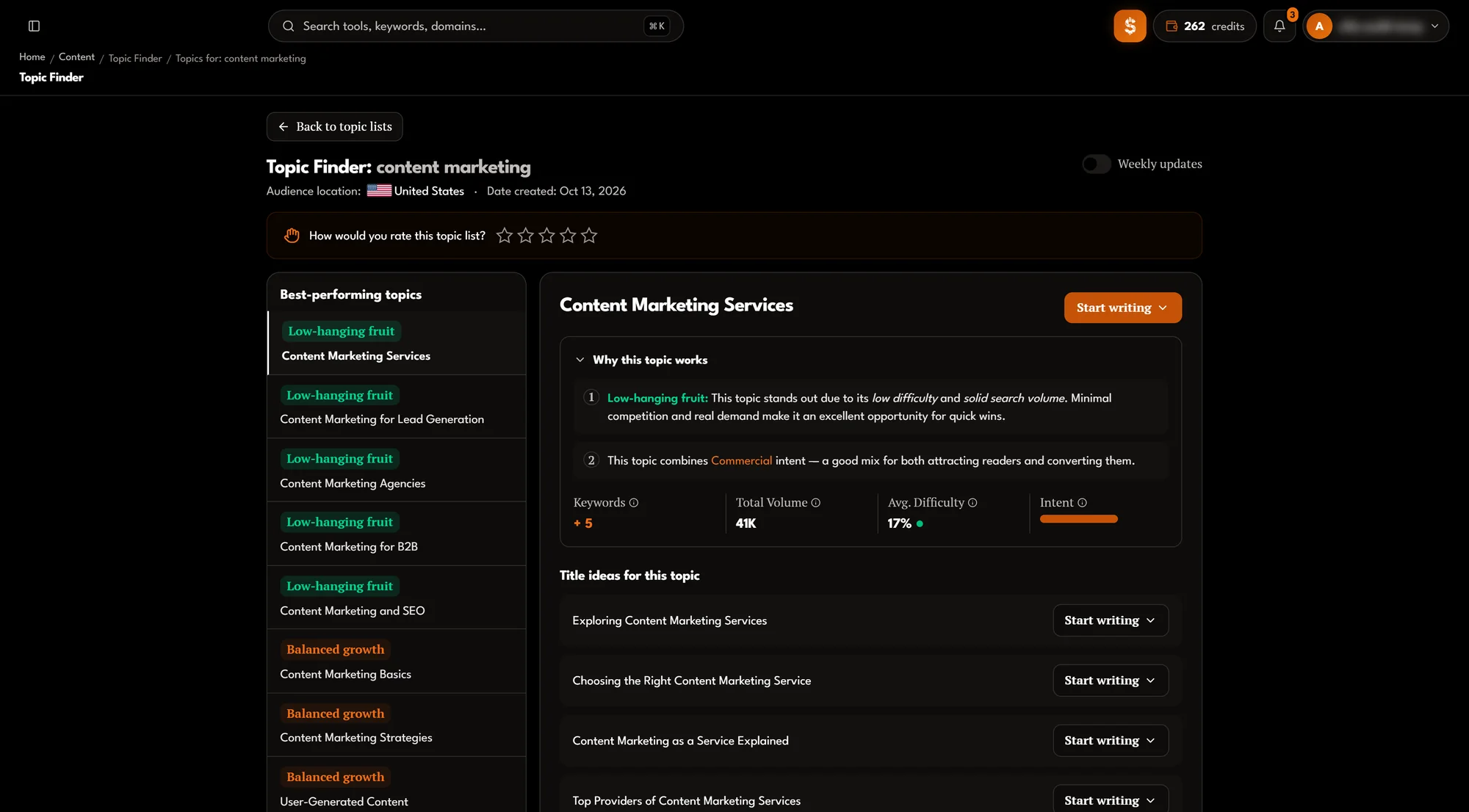
What a run returns
Topics grouped from real keyword data.
Topics with no search demand do not get read, and topics that are too competitive do not get found. Topic Finder groups real keyword data into topics and labels which are quick wins and which are longer plays.
- 1
Up to 12 topic ideas per run
- 2
For each topic: keyword count, search volume, average difficulty and intents
- 3
A label marking quick wins ("Low-hanging fruit") or longer plays ("Balanced growth")
- 4
Up to five title suggestions per topic
Quick wins and longer plays
This month
Low-hanging fruit
Topics where demand is reachable at low difficulty: candidates for the next few weeks.
This quarter
Balanced growth
Topics worth building toward, with more demand and more competition.
- Keyword count
- How many searches sit behind a topic. More keywords means one article can attract more varied traffic.
- Volume and average difficulty
- The topic's combined demand and how hard its keywords are on average.
After a topic
From idea to draft without losing the data.
Topic Finder
Pick a topic and a title.
Brief it against what ranks.
Draft
Start a draft from the topic (priced separately).
Check it before publishing.
A way to use it
For example: filling next month's calendar
- Enter "home composting".
- Keep the topics labelled Low-hanging fruit.
- Pick a title from the suggestions for each one.
- Brief the first with SEO Brief Generator, or start a draft from the topic.
What it costs
- Topic runper run
- 5 credits (£0.50)
Prices are in credits. £1 buys 10 credits, so 1 credit is 10p. The price is shown on the button before you run anything. Saved reports (Keyword Finder, Keyword Snapshot, Competitor Gap, Content Clusters and Site Audit) re-open free.
What it does not do
- It suggests topics; it does not structure a whole site. Content Clusters does that.
- Starting a draft from a topic uses article generation, which is priced separately.
Questions
Where do the topics come from?
From real keyword data for your subject, grouped into topics, with the volume and difficulty of the keywords behind each one.
How many topics does one run give me?
Up to 12. Each comes with its keyword count, total search volume, average difficulty, the search intents behind it, and up to five title suggestions.
What do "Low-hanging fruit" and "Balanced growth" mean?
Low-hanging fruit: an average difficulty under 35 with at least 1,000 searches a month, a quick win. Every other topic is Balanced growth, a longer play. Quick wins are listed first.
Does it write the article?
No. Pick a topic and start a draft from it; writing the article uses article generation, which is priced separately. A topic run itself is 5 credits.
How is it different from Content Clusters?
Topic Finder suggests what to write next. Content Clusters plans a whole subject as pillar pages and subpages, for structuring a site.